Bosgame M5 Ai Mini Pc First Look: Unboxing and Impressions
Introduction
The Bosgame M5 Ai Mini Pc arrives at a time when compact desktop systems are evolving beyond simple office machines into capable platforms for creativity, media playback, light gaming, and even on-device AI inference. This first-look article walks through the unboxing, design impressions, ports and connectivity, expected performance characteristics, real-world use cases, and purchasing considerations. The goal is to give readers who are shopping in the mini PC category a practical, unbiased view of what the Bosgame M5 Ai Mini Pc offers and how it compares to similar small-form-factor machines.
What to Expect in the Box
Out of the box, the Bosgame M5 Ai Mini Pc typically includes the unit itself, a compact external power brick, a power cable appropriate for the market, and basic documentation (quick start guide and warranty card). Depending on the specific seller or configuration, some SKUs may ship with pre-installed memory and storage while others are sold as barebones units intended for user upgrades. The packaging is minimal and protective, consistent with other small-form-factor vendors.
Design and Build
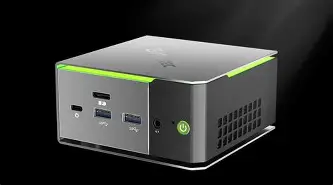
At first glance, the Bosgame M5 Ai Mini Pc follows the standard compact cube / rectangular aesthetic common to modern mini PCs. The chassis is small enough to sit on a desk beside a laptop or be tucked behind a monitor using a VESA mount. Materials vary by SKU but are typically a mix of metal and high-quality plastic that balance heat dissipation and cost.
Attention to practical details is important in this class: rubber feet to reduce vibration, a removable bottom or top panel for RAM and storage access, and a logical port layout for everyday use. The M5’s cooling vents and fan intakes are positioned to reduce noise spillage forward toward the user, which matters for home-office or living-room deployments.
Ports and Connectivity
Port selection is one of the main decision points for mini PC buyers, and the Bosgame M5 Ai Mini Pc includes a selection aimed at versatility. Typical options observed across configurations include:
- Multiple display outputs (HDMI and/or DisplayPort) for dual- or triple-monitor setups
- USB-A and USB-C ports, with at least one supporting high-speed data and (in some SKUs) Power Delivery for charging peripherals
- Gigabit or 2.5Gb Ethernet for wired networking and better-than-Wi-Fi stability for streaming or local servers
- Audio jack and sometimes optical audio output for home-theater use
- M.2 slot(s) and a 2.5" bay (depending on model) to expand storage
Wireless connectivity usually includes Wi‑Fi 6 and Bluetooth 5.x in modern mini PCs; potential buyers should check the exact wireless chipset included if strong wireless performance is a priority.
Internal Expandability and Upgradability
Upgradability separates cheap disposable PCs from long-lived investments. The Bosgame M5 Ai Mini Pc generally supports user-accessible memory and storage upgrades via an easy-open panel. Common configurations ship with one or two SODIMM slots (supporting DDR4 or DDR5 depending on the SKU) and at least one M.2 NVMe slot for fast storage. Some configurations may also include a 2.5" drive bay for larger-capacity SATA drives.
Buyers who plan to run virtual machines, local AI models, or heavy multitasking should prioritize models with two RAM slots and support for higher capacity modules. The presence of an accessible M.2 slot makes future SSD upgrades straightforward.
Performance and AI Capabilities
The “Ai” in the product name signals a focus on local AI acceleration. In practice, this class of mini PC often includes a hardware NPU (Neural Processing Unit) or integrates CPUs/GPUs that offer improved on-device inferencing performance compared to generic integrated graphics alone. The Bosgame M5 Ai Mini Pc aims to provide faster inference for tasks such as speech recognition, image classification, or lightweight generative tasks when paired with appropriate software.
Performance will vary significantly by chosen CPU and the presence or absence of a dedicated accelerator. Typical options for mini PCs include efficient Intel or AMD processors that offer a balance of single-thread performance and low power draw. For GPU-heavy workloads or local model training, an external GPU would still be required; the M5 is better suited to inference and model prototyping at the edge rather than heavy training.
Shop the latest Laptops & Computers picks on Amazon.
Shop Amazon →For everyday workflows — office productivity, web browsing, video streaming, light photo editing, and media server duties — a mid-range CPU and NVMe storage produce a responsive experience. Content creators working in non-linear editing should confirm the chosen configuration’s memory and storage throughput before purchase.
Thermals and Acoustic Performance
Thermals and noise are practical concerns for a device that lives on a desk or media cabinet. The Bosgame M5 Ai Mini Pc uses a small active cooling solution. In quiet workloads (browsing, document editing, streaming), the unit should remain nearly silent. Under sustained load — such as prolonged compilation tasks, video transcodes, or continuous AI inference — chassis temperatures and fan noise will rise. Buyers sensitive to noise should prioritize models with better passive cooling designs or consider placement away from the immediate listening position.
Software, Drivers and OS Support
Mini PCs in this category generally ship with Windows 11 or with a choice of Windows and Linux. Driver maturity for any included NPU or other accelerators varies; strong vendor support and up-to-date drivers are essential for smooth AI workflows. The Bosgame M5 Ai Mini Pc will be most useful for buyers who need reliable Windows-based operation, or for developers comfortable with installing drivers and libraries on Linux for AI work.
Open-source AI frameworks (TensorFlow Lite, ONNX Runtime, OpenVINO, and vendor-specific SDKs) are commonly used to take advantage of on-device accelerators. Prospective users should verify the vendor’s documentation and community support if they plan to do serious edge-AI development.
Real-World Use Cases
The Bosgame M5 Ai Mini Pc targets a number of practical scenarios where compact form factor and moderate compute matter:
- Home Office and Remote Work: A compact desktop for multiple displays, video conferencing, and productivity apps where desk real estate is limited.
- Media Center / Living Room PC: Quiet streaming of 4K content, image upscaling, and a small footprint for home theater setups.
- Edge AI / IoT Gateway: Local inferencing for cameras, voice assistants, or sensor fusion where on-device processing reduces cloud dependency and latency.
- Developer Workstation (Light): Software development, containerized testing, and building small projects without the overhead of a full tower workstation.
- Small Business Server: Network-attached services, light virtualization, or a compact point-of-sale controller where 24/7 operation and stable networking are required.
Buyers should match configuration to workload: more RAM and NVMe storage for multitasking and development, plus an NPU-enabled SKU for local AI inference.
Pros & Cons
Pros
- Compact footprint that frees desk space and fits behind monitors or in tight media cabinets.
- Potential on-device AI acceleration for low-latency inferencing and edge AI use cases.
- User-upgradeable memory and NVMe storage in many configurations.
- Balanced port selection for real-world connectivity (multiple displays, wired LAN, USB-C).
- Lower power draw compared to full-sized desktops making it suitable for continuous operation.
Cons
- Thermals can limit sustained peak performance compared to larger desktop PCs.
- AI acceleration benefits depend heavily on software and driver support — not all frameworks will take full advantage of on-device NPUs out of the box.
- Limited GPU capability for heavy graphics workloads or model training.
- Some SKUs may ship as barebones requiring separate purchase of RAM, storage, and OS which complicates comparisons.
How the Bosgame M5 Ai Mini Pc Compares
For buyers deciding between compact systems, the following comparison table highlights how the Bosgame M5 Ai Mini Pc positions itself versus two representative alternatives: a mainstream Intel NUC-style mini PC and a small-form-factor unit from a specialist mini-PC vendor. These categories are generalized — specific models will vary in detail and performance.
| Feature | Bosgame M5 Ai Mini Pc | Typical Intel NUC-style Mini PC | Specialist Mini-PC (e.g., compact workstation) |
|---|---|---|---|
| Target Use | Edge AI inference, home-office, media | General-purpose desktop, productivity, light media | High-performance compact workstation, content creation |
| AI Acceleration | Often includes NPU or AI-focused silicon (varies by SKU) | Usually relies on CPU or integrated GPU only | May include discrete GPU options for acceleration |
| Upgradability | SODIMM slots and M.2 NVMe; some models support 2.5" drives | Similar SODIMM/M.2 options on many models | More expansion room; sometimes multiple M.2 and PCIe lanes |
| Ports | Multiple displays, USB-A/C, Ethernet (1Gb/2.5Gb possible) | Good mix of ports; often limited to two displays | Extensive I/O, more USB lanes, potentially Thunderbolt |
| Thermals & Noise | Quiet in light use; fans audible under load | Similar behavior; improved designs may be quieter | Better thermal headroom; quieter under load |
| Price Range | Mid-range (configuration dependent) | Wide range from budget to premium | Premium for higher performance models |
Buying Guide: How to Choose the Right Configuration
Choosing the right Bosgame M5 Ai Mini Pc configuration requires matching the machine’s strengths to the buyer’s needs. The following checklist helps clarify priorities so buyers pick a configuration that fits their intended use.
1. Define the primary workload
If the main tasks are office productivity and web conferencing, prioritize a balanced CPU and 8–16GB of RAM. For media editing or multitasking, aim for 16–32GB. If local AI inference or edge processing is essential, prioritize an SKU with a dedicated NPU or AI accelerator and check supported frameworks.
Discover deals on Laptops & Computers — updated daily.
Browse Now →2. Memory and Storage
Upgradeability matters. Choose a model with two RAM slots if future expandability is desired. Opt for NVMe storage for system responsiveness — the fastest SSDs improve boot times and application load times significantly. If large media libraries are involved, consider models with a 2.5" drive bay or plan a networked storage solution.
3. Connectivity and Displays
Confirm the number and type of display outputs for multi-monitor setups. For stable streaming and remote office use, prefer wired Ethernet (preferably 2.5Gb if available). If using wireless heavily, verify the Wi‑Fi 6/6E and Bluetooth version.
4. Software and Ecosystem
For AI and developer use, check vendor documentation for driver support and sample code. Confirm whether Windows drivers and Linux support are both available and how often they are updated. Community forums and vendor responsiveness to issues are important when specialized hardware is involved.
5. Thermal and Acoustic Expectations
Place the unit where fan noise is acceptable. If the device will run 24/7 for server tasks, ensure adequate ventilation and consider a configuration with stronger thermal handling or an external cooling strategy.
6. Warranty and Support
Check warranty terms and customer support reputation. For business-critical deployments, a longer warranty and responsive support channels reduce downtime risk.
Practical Tips and Final Impressions
In day-to-day use, mini PCs like the Bosgame M5 Ai Mini Pc shine for their convenience and low visual footprint. They fit in spaces where a tower cannot and generally consume less power. For users who want local AI capabilities — such as small office voice assistants, on-premises camera analytics, or fast offline inference — the M5’s AI orientation is a meaningful differentiator, but only when paired with compatible software stacks.
Buyers should treat the M5 as a building block rather than a finished workstation unless they select a fully specced SKU. Many users will benefit from purchasing additional RAM and a high-quality NVMe drive at time of purchase rather than upgrading later, as that reduces downtime and setup work.
Conclusion
The Bosgame M5 Ai Mini Pc is a pragmatic entrant in a growing category of compact, versatile desktops. Its emphasis on AI-capable hardware makes it interesting for buyers exploring edge inference or local machine learning tasks, while its small size and typical port selection keep it attractive for home-office and media uses. As with any mini PC, the actual experience depends heavily on the chosen configuration — especially RAM, storage, and whether an NPU is present and well-supported by drivers. For buyers seeking a low-power, space-saving machine that can handle everyday computing and dabble in on-device AI, the M5 is worth considering; prospective purchasers should compare configurations carefully and verify software support for their targeted AI frameworks before committing.